


When you are selling something that is not FMCG (fast moving consumer goods; fast food, drinks, etc.), you cannot expect people to come with their wallets out. You are asking a good chunk of their hard-earned money, so you want to approach them differently. They don't even know you, so why would they work with you? Let them know who you are; prove your expertise on the subject matter, gain their trust, and they will talk.
So, how do we attract traffic and convert them into sales leads? Simple. We make helpful, free content, and make sure it falls on the right audience. In this article, we will discuss the ways you can attract people through search engine optimization (SEO), into your website.
Step One: Know Your Target
Your buyers are not a single group of people. Some of them don't know what kind of solution they need for their problems. Some of them are first-time buyers, while some others are experienced users who want improvements. Some simply have too much money and looking for the absolute best products and services. Some will be on tight budget. You need ask yourself a question: which ones are my targeted audience?
Step Two: Research On What Your Customers Seek
Example
Say, you are selling point-of-sale (cashier) software in the form of subscription service. You know that your main potential customers have following characteristics:
- Small shops
- Located in big cities with significant traffic
- Looking for cheaper alternatives compared to well-known softwares
- Have been in operation for less than 3 years
You can imagine them typing these phrases on Google or TikTok:
- “Affordable POS software”
- “Best cashier software”
- “Cheap cashier software for pet shops”
…and so on. You can use tools such as SEMrush, Ahrefs, Mangools, or others to help looking for these keywords. These tools will tell you how many people actually look for those phrases in their search bars.
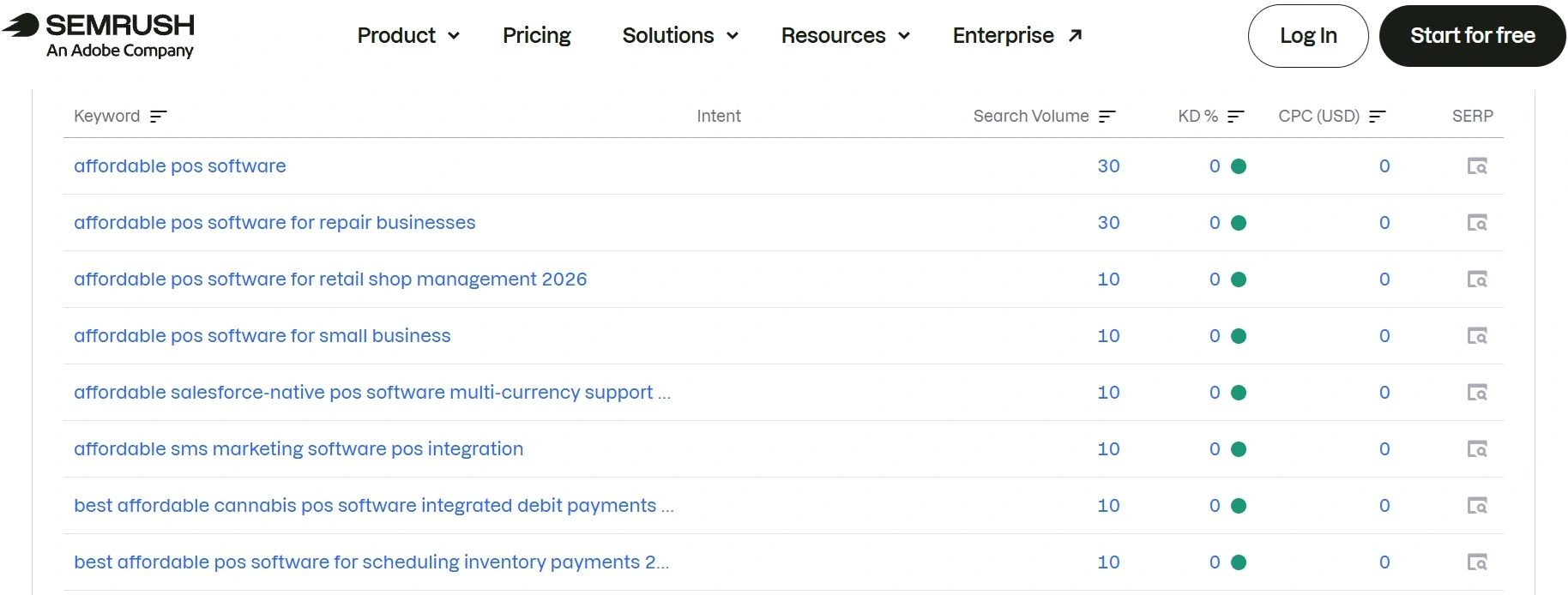
Your job is to find keywords that most of your potential customers are searching for. These are the topics that you want to talk about in your blog articles, YouTube videos, social media posts, and everything in between.
There are two goals in making SEO content. The first one is to attract potential customers and lure them into contacting you for a sales pitch meeting. The second goal is to convince Google and social media algorithms that your company is highly trustworthy, and should appear at the top of people's search results.
Based on these goals, there will be two types of content that you are making. One is for informational purposes where people can read useful stuff, so that algorithms will put your channel on top. This one is called informational content. An example would be “5 Steps to Start a Coffee Shop”. With informational content, you want to reach as many people as possible.
Second type of content is intended to persuade people into trying your products. This one is called commercial content. An example would be “10 Tools Every Coffee Shop Must Have”, where your software is one of them. With commercial content, we want to make your software company appear as top results on AI, Google Maps search, and so on.
Step Three: Planning Content Creation
Now that you have the topics you want to talk about in your content, you are getting ready to write drafts. But, what is a good content? What kind of articles that Google will put on top, and what kind of videos will YouTube or TikTok recommend to your targeted audience?
There are three things you want to pay attention to: quality, technical SEO, and consistency. Let us walk through them.
Quality
As much as we hate saying it, Google has a formula that became the standard for measuring content quality, especially for websites. This formula more or less sums up how content is distributed all over the internet. It is called E-E-A-T, which stands for “Experience, Expertise, Authority, and Trust”.
“Experience” means that your content is telling a story from the perspective of a person who genuinely went through that storyline. For example, let's say you want to teach your daughter how to shoot a basketball, but you are not an athlete yourself. You will seek guidance by typing “how to shoot a basketball” on YouTube or Google (which might as well recommend short videos also).
Imagine there are two videos: a national athlete who shows step-by-step guide, and a random person who just talks and summarizes different theories of shooting forms using slideshow illustrations. Which one do you think has the higher quality? Without question, a person showing you how to do something is always more valuable that a person talking about it.
It does not matter if you are writing articles or making videos; you should always talk from experience and bring insights to your audience from your own knowledge. This is important: the internet will reward content that brings new information, and not a recycled one.
The internet will reward content that brings new information, not a recycled one.
“Expertise” means who you are. If you are a software developer with 10+ years of experience, used to work for reputable companies, and now you are making content about cashier software for small businesses, the algorithm will be more likely to favor you over nameless content creators.
“Authority” means that the platform where you publish your content has the credentials and editorial reputation needed to discuss your topic. An article about basketball will be worth way more if it was posted on a sports magazine than Facebook or Reddit, or some random unknown website. Please remember that certain topics such as finance, medicine, cybersecurity, or other Your Money/Your Life topics (Google calls it YMYL) will require specific academic and professional credentials in order to appear on search results. If you don't have the necessary credentials, you might have to hire a credible expert to write about your company or products.
“Trust” means that your article is being used as reference by academics, writers, or other people and websites who already have some degree of authority on the internet (see the previous paragraph). When these people make videos and articles that give links to your content, it is going to boost the “trust level” of both your content and your persona.
Based on those parameters, this is what a god-tier SEO content would look like:
| Experience | Your own experience training as a kid and competing professionally, and you have never talked about this anywhere else |
|---|---|
| Expertise | You are Michael Jordan |
| Authority | Your article is published on Sports Illustrated magazine, complete with video guide |
| Trust | Your article is referred by a gazillion academic journals on sport science |
That is surely an extreme example, but you get the point. We now know how to improve content quality using ‘Experience’ and ‘Expertise’, but how do we make sure the algorithm gets it? How do we improve ‘Authority’ and ‘Trust’?
Technical SEO
The word “technical” here only means sending the right signal for the algorithm. Think of “algorithm” as an engine that crawls all over the internet, chewing all kinds of content available, while constantly asking these three questions:
- What kind of content is this?
- Who made it?
- Who published it?
Based on those questions, the algorithm will deliver links, articles, images, and videos, hopefully to the right audience. Our job is to help answering those three questions, making it crystal clear for the algorithm.
First, you want to make sure that your content is easy to understand. Your articles should have heading structures, so that the readers (and algorithms) can comprehend your topic easily. If your content contains images and diagrams, provide alt texts and captions. Make sure your videos have accurate subtitles and clear images. Give external links when referencing to other sources. Give disclaimers to make sure you don't misguide people. You can easily consult AI to judge whether your videos, infographics, and articles are easily understandable by a machine (since AI LLMs are run by machines).
Second, you want to make sure that your profile as a persona is visible to the internet. When someone Google your name, it must be clear who you are, what you do, what you know, what you have contributed to, and what your affiliations are. You can showcase your credentials on your own website (make sure that it is indexed by search engines), LinkedIn, Google Scholar, even other social media (especially those where you can verify your profile). Make sure that every content you have on the internet has a short biography of you, as the author.
Third, you want to make sure that the site where you publish content is as credible as possible. When writing and shooting videos for your own company website, make sure your site has an “About Us” and “Contact” page, with complete address, legal credentials, emails and active phone numbers. Add a dedicated page containing profiles and resumes of every team member and content author if you can. Use schema markups on your HTML code to specify what kind of website you are running. Hire a proper website developer, get a good site structure and make sure that the page performance is decent. Add a comment section and engage with your audience for extra credibility.
Finally, you should promote your content and encourage people to share, use, quote, and refer them. Ask local news portals to write about your newly opened coffee shop, and tell them to give an external link in their article which leads to your site and social media. Ask coffee bloggers to use your articles as reference, and make sure their blogs have links to yours (and you can return the favor by doing the same for them). Ask your customers to leave reviews on your Google Business page. This is called backlink building, and it gives a signal to algorithms that your content (and site) is trustworthy.
Consistency
Some of your content will do well, and most of them won't. Do not get tempted to publish hundreds of generic AI generated videos and articles, trying to get lucky with traffic. Instead, try uploading weekly, and increase the quality as you become more experienced.
If you can reproduce your content into different formats on different platforms, it is going to help. Write long articles on websites, publish long-form videos on YouTube, and summarize it on TikTok or Instagram.
Finally, you must keep track of your content performance. The most valuable data for you, is knowing which content performs well and how to replicate the success. If your software company is pulling traffic by its expert programmers who write blogs on international hacking competitions, then you know what to do. If your company goes viral by certain funny posts on TikTok, then you also know what to do (or sort of).
Closer
The world is getting polluted with AI slops, and the easiest way to stand out is by making original, genuinely useful content, that people will recognize as human-made. Start now, and let us know if you need any help.